How we work
We do the investigating. You make the call.
Most of what we do is find out what's actually true. That's the part that takes weeks. The recommendations come out of it in days, and they're worth nothing if the weeks didn't happen.
The shape
Nearly every engagement starts the same way: an assessment, then hands-on operating work, then we taper out.
Assessment
Operating
Advisory
Find out what’s happening and sequence the fix
Build the systems and run them alongside your team
Your people own it. We’re available when something new breaks.
The assessment is typically four weeks. A team of 10 to 15 usually takes less, and it only runs longer for an organization past 75 or so. Everything after it depends on what it finds.
The assessment
What happens across the four weeks.
Assess
Analyze
Align
Activate
What you get
A graded report, by area, with the case for and against each one written out plainly.
Every finding in it carries a reference number, and every reference maps back to the conversation it came from. The interview it surfaced in. The meeting we watched. The document we read.
Then the sequence: what to fix first, what has to wait, and why that order.
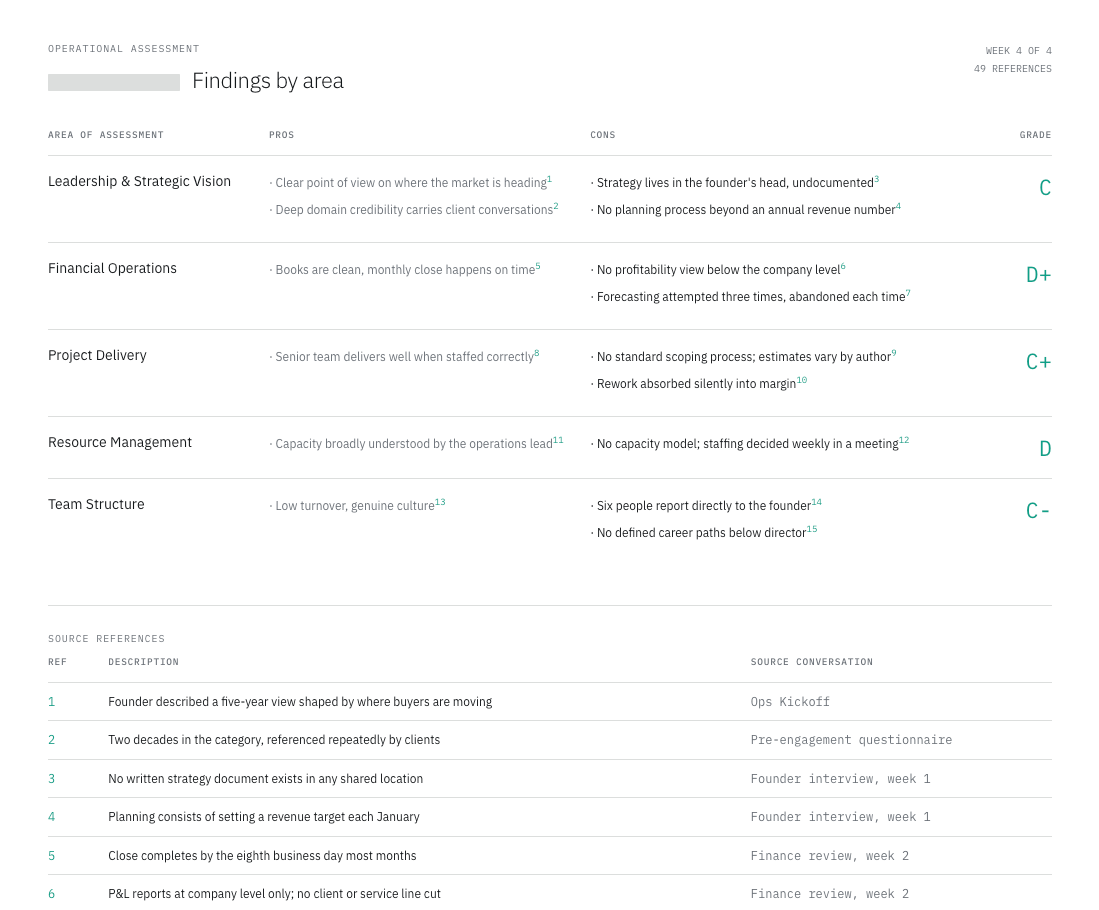
See where this has landed for five firms.
The operating stretch
The assessment is a document. The next six to nine months is the part that changes anything.
We work inside your business, not next to it. Building the financial visibility, defining the roles, installing the leadership cadence, rebuilding the workflows. Whatever the assessment said to do first.
We own the investigation and the recommendation. You own the decision and you own the outcome. That distinction is deliberate: an operator who makes your decisions for you creates a business that needs them permanently.
The goal is that your team can make these calls without us.
So the work tapers. What we were running, your people start running, and we move to advisory while they do it. If we're still as embedded at month twelve as we were at month three, something has gone wrong.
Most firms keep a light advisory relationship after that. Some don't need one.
Who does it
Two disciplines, both in from the start.
Operating
Org design, financial visibility, leadership cadence, and how work moves through the business.
Automation
What happens to those workflows once they're defined: what should run itself, what stays manual on purpose, and where AI does real work instead of demo work.
Those aren't separate engagements and the second one isn't sold to you later. Automation is in the room from the assessment forward.
The operating work is us, directly. Not a bench, not a junior consultant with a partner who shows up for the QBR.
When something falls outside both disciplines, we bring in someone who does it for a living rather than learning on your budget. Executive coaching, recruiting, legal, go-to-market. They come in on the specific piece and then they're done.
What it costs
We don't quote before we understand the scope.
Assessment
A fixed fee, set by the size and complexity of the business. We name it on the first call, once we know both.
Operating
A monthly retainer against a defined number of hours.
Term
Three months to start, then month to month.
Notice
30 days, either side.
Nobody should be locked into this.
Two ways in
Take the assessment and see where you sit. Twenty-three questions, about seven minutes, no call required.
Take the assessmentOr if you'd rather just talk, book thirty minutes.